More Graphene Does Not Always Mean Better Results:
The Importance of Dispersion in the Coatings Industry
Graphene is a material composed of a single layer of carbon atoms arranged in a two-dimensional structure. Since its isolation in 2004, it has drawn interest across multiple industrial sectors due to its mechanical, thermal, electrical, and optical properties, among others. However, the properties of one or several graphene sheets are not automatically transferred to any given product.
One of the applications of greatest interest is the development of industrial coatings. Graphene and its derivatives, such as graphene oxide or reduced graphene oxide, exhibit sheet-like geometries that, when favorably distributed and oriented within a matrix, can impede the transport of water, oxygen, and corrosive ions. This phenomenon, known as the barrier effect, offers opportunities to enhance the protection of both metallic and non-metallic surfaces.
Its high surface area and interactions with polymer matrices can also modify adhesion, wettability, and other coating properties. Nevertheless, translating this potential into homogeneous, cost-effective, and scalable industrial formulations requires overcoming a common misconception: incorporating more graphene guarantees better results.
Why Does a Higher Concentration Not Always Improve Performance?
The high specific surface area of graphene materials favors sheet-to-sheet interactions and, under certain conditions, the formation of agglomerates. If the formulation fails to distribute them adequately, heterogeneities and defects may appear, counteracting the benefits of reinforcement. Therefore, increasing the nanomaterial load can even impair certain properties.
The recurring points of debate across various lines of research utilizing graphene or any of its derivatives are typically: concentration of the graphene material, its compatibility with other components, dispersion quality, and the integrity of the final film as key variables for coating modifications, particularly regarding mechanical strength and corrosion resistance.
Importance of Concentration and Dispersion
A formulation that appears uniform to the naked eye may contain microscopic agglomerates. Effective dispersion requires considering the separation and stability of the sheets, their affinity for the formulation components, and their distribution during dry film formation. A good initial dispersion in the liquid medium does not, by itself, guarantee proper distribution in the finished coating.
Studies on epoxy coatings reinforced with graphene materials have reported how dispersion stability and sheet organization can influence corrosion protection. Thus, it is essential not only to know how much graphene to incorporate, but also which material to select and how to ensure that a sufficient proportion is integrated and functional within the matrix.

Adhesion and Corrosion: Related, but Not Equivalent
Greater adhesion can contribute to preserving the integrity of the protective system, but it does not in itself demonstrate higher corrosion resistance. The latter also depends on permeability, porosity, film continuity and thickness, the nature of the substrate, and exposure conditions.
Similarly, an increase in the water contact angle indicates lower surface wettability, but it does not, on its own, justify claiming a reduction in coating absorption or permeability. Evaluating the protective effect requires considering the full set of properties and, where applicable, conducting electrochemical or controlled exposure tests.
Energeia-Graphenemex®: From Research to Industrial Application
The technical and economic viability of graphene materials at an industrial scale requires translating theoretical results into real-world applications outside controlled laboratory environments. To this end, Energeia-Graphenemex® has been dedicated since its inception to evaluating the efficiency of its materials across diverse systems and environments.
As part of this effort, in 2024 the company published the article “Construction Innovation – Graphene Oxide as the Differentiating Nanoadditive for Concrete and Coatings” in the international journal Materials Science Forum. In doing so, the company has consolidated a technical validation pathway for the use of its nanomaterials, reaffirming the effectiveness of its formulations in ecological, epoxy, acrylic, and polyurethane matrices, which have demonstrated significant improvements in corrosion protection, antimicrobial activity, mechanical strength, and weather stability.
In studies conducted in 2026, the performance of a water-borne coating was compared against a system modified with different concentrations and types of graphene material, both applied to metallic surfaces.
The results were consistent with previously identified findings under other conditions, demonstrating that less than 1% of graphene material is sufficient to improve coating adhesion to the substrate as well as the integrity of the coating itself. In this study, the increase in pull-off adhesion strength exceeded 130% compared to the unmodified coating. Meanwhile, adhesion testing using the Cross-Cut method also confirmed its performance, advancing from Category 4B to 5B, achieving the maximum level of performance on this scale.
Category 4B: Slight flaking along the intersections of the cuts; affected area does not exceed 5% of the lattice.
Category 5B: Edges of the cuts are completely smooth; none of the squares of the lattice is detached.
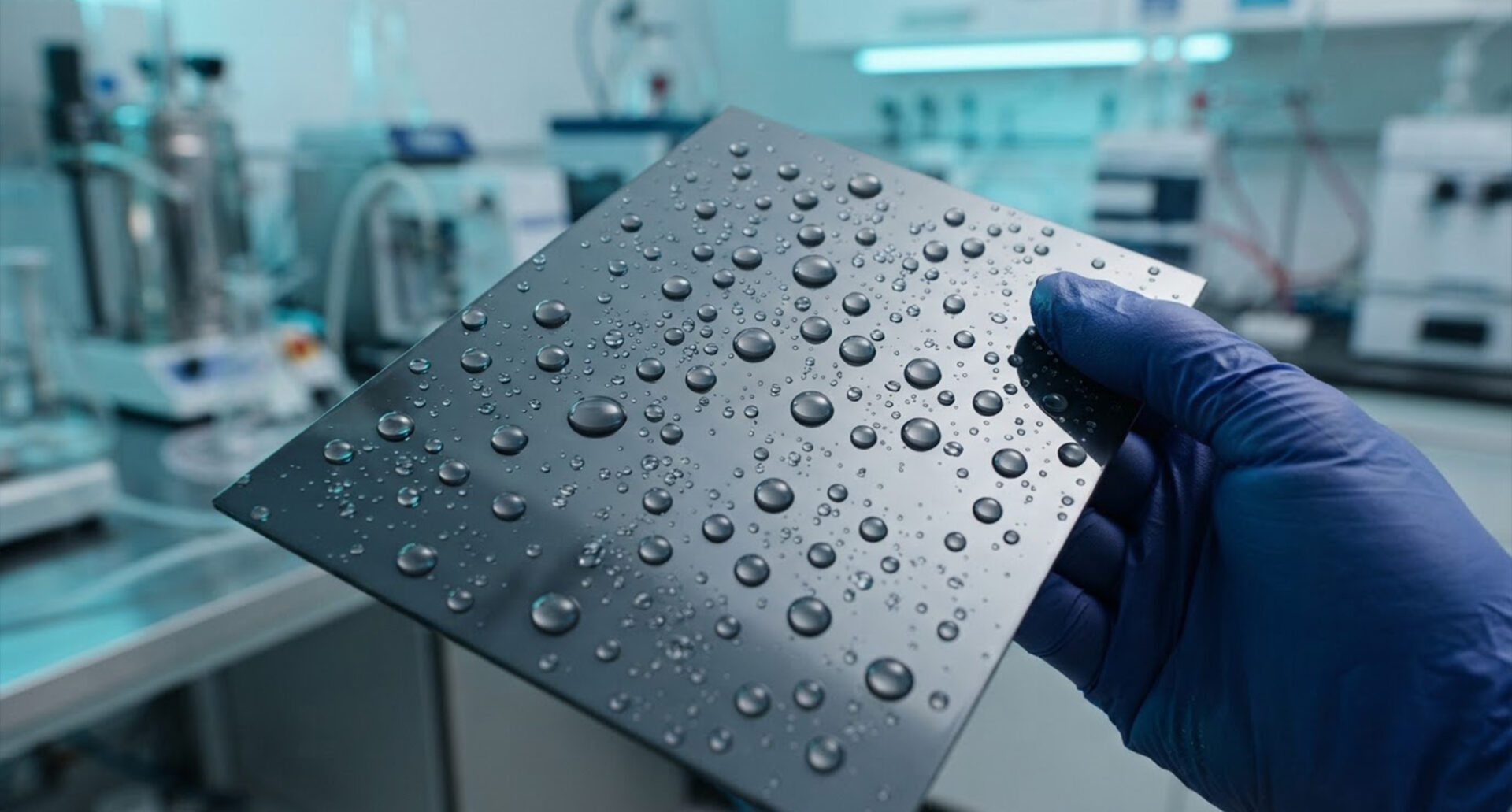
Finally, the coating modified with the graphene material also proved to be 20% more hydrophobic. Working in synergy, all these changes resulted in a coating with superior anticorrosion performance, once again highlighting the great potential of graphene materials for substrate protection.
The advancements of Energeia-Graphenemex® highlight the core challenge of applied nanotechnology: translating the theoretical characteristics of a nanomaterial into reproducible, homogeneous, and economically viable functional properties. In all industrial sectors where graphene materials can add value, success lies in identifying the right balance among the nanomaterial, its concentration, and interfacial dispersion methods.
Writing: EF/Dania Hernández
References
- Review of the Application of Graphene-Based Coatings as Anticorrosion Layers. Coatings (2020), 10, 883. DOI: https://doi.org/10.3390/coatings10090883
- Composites Part A: Applied Science and Manufacturing (2023), article 107729. DOI: https://doi.org/10.1016/j.compositesa.2023.107729
- Dispersion and Parallel Assembly of Sulfonated Graphene in Waterborne Epoxy Anticorrosion Coatings. Journal of Materials Chemistry A (2019). https://doi.org/10.1039/C9TA03995C
- Progress in the Graphene Oxide-Based Composite Coatings for Anticorrosion of Metal Materials. Coatings (2023), 13, 1120. https://doi.org/10.3390/coatings13061120
- Construction Innovation – Graphene Oxide as the Differentiating Nanoadditive for Concrete and Coatings. Materials Science Forum (2024). https://doi.org/10.4028/p-l9NF7j