The future of water is nano:
How graphene is revolutionizing industrial filtration.
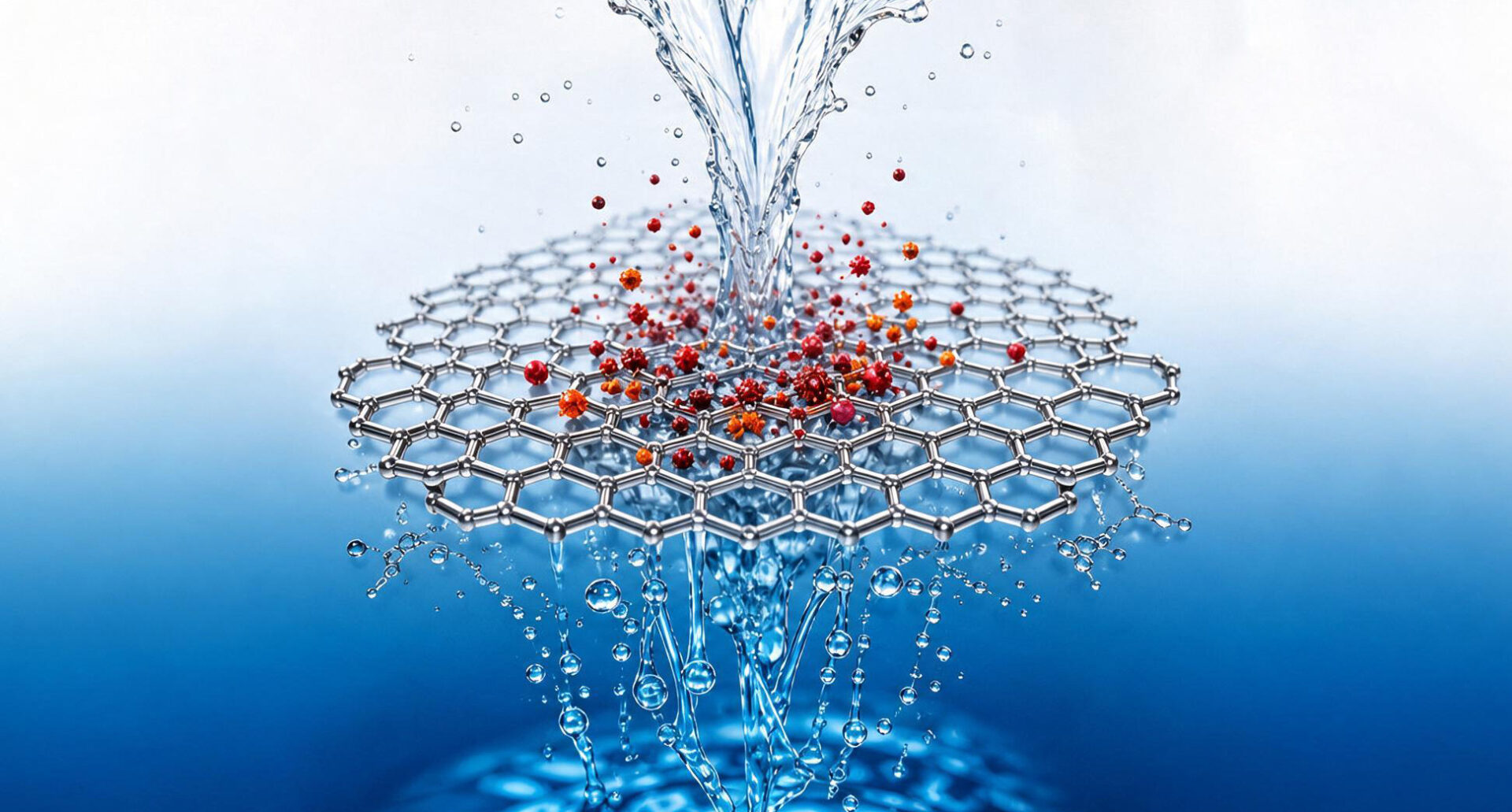
Graphene materials are a family of carbon nanostructures organized in a sheet-like hexagonal pattern, which are in turn classified according to the number of layers, morphology, and surface chemistry. However, the most well-known is graphene, which essentially consists of carbon atoms, famous for its high mechanical strength, among many other thermal, electrical properties, etc., and graphene oxide which, in addition to carbon, contains oxygenated functional groups that favor its interaction with water and other substances.
In the water technology sector, graphene materials are transforming the design of nanotechnological filtration barriers. By being integrated into the modification of both filters and membranes, graphene has the challenge of meeting two major objectives: The first is to optimize selectivity, that is, to improve control over the components that manage to pass through the barrier and those that are rejected. This is achieved through the creation of nanochannels between the sheets that limit the passage of contaminants by size exclusion, or rather, through chemical adsorption mechanisms. The second objective is to maximize filtration efficiency. When incorporated into the structure, graphene reinforces the mechanical properties of the base polymers and provides notable resistance to fouling (antifouling). Consequently, these improvements mitigate the pressure drop, maintain a constant water flow, and reduce energy consumption during system operation.
Are there filters and membranes made solely of graphene?
A frequent mistake is to think that a filtering material can be manufactured solely with graphene. This is because, although this family of nanomaterials is sheet-shaped, its size is so small that, in order to be used as a membrane or filter, it is necessary to immobilize them on a porous support or incorporate them into a polymeric matrix. Therefore, it is most convenient to conceive these nanostructures as materials capable of modifying or complementing the properties of pre-existing materials, but from a nano perspective.
“A nanometer is equivalent to 0.000001 millimeters”
“The difference between a filter and a membrane lies in the pore size, the contaminant separation mechanism, and the pressure required to operate the system”
How are graphene materials integrated into a filtering material?
In the race to achieve the objectives, the scientific community has studied different methods to incorporate graphene into filters and membranes. Some methodologies are relatively simple and fast, while others require more complex processes.
The most common reported methods are:
1. Filtration deposition
It consists of preparing a dispersion of graphene material at a known concentration, to later filter it with a commercial membrane (e.g., polysulfone, polyamide, polyvinylidene fluoride (PVDF), polyethersulfone (PES), cellulose or nylon). During the process, the graphene material nanoparticles randomly arrange themselves, forming an ideally continuous film on the base polymer.
2. Dip coating
It consists of introducing a commercial membrane, like those mentioned in the previous method, into a dispersion of graphene material for a certain time. The immersion aims for the nanoparticles to adsorb onto the membrane to form a film.
These first two methods are probably the most used in the laboratory. They are simple and fast procedures, but with the disadvantages of being difficult to scale, not very stable, and not very uniform. Although with the advantage of providing relevant information about the behavior of each material.
3. Layer-by-layer
With this technique, more ordered structures are formed, as it consists of depositing intercalated layers of positively and negatively charged graphene material.
Among its advantages is excellent control of thickness, uniformity, and selectivity. In fact, this method has shown interesting results for applications that require greater selectivity and resistance to fouling. However, the manufacturing process is relatively slow for mass production; it requires additional chemical modifications to the nanomaterial to change its charge, and the membrane can be so compact that the water flow is likely limited.
4. Direct blending with polymers
In industrial terms, this method is the alternative with the greatest potential. Instead of depositing the graphene material on a finished product, the strategy is to take advantage of existing processes and infrastructure to incorporate the nanomaterial during the manufacture of the filtering material. In this way, graphene is integrated throughout the architecture of the final product from its origin.
“The challenge of graphene is not to prove whether it works or not inside a laboratory, but to integrate it into industrial processes.”
From the laboratory to the market
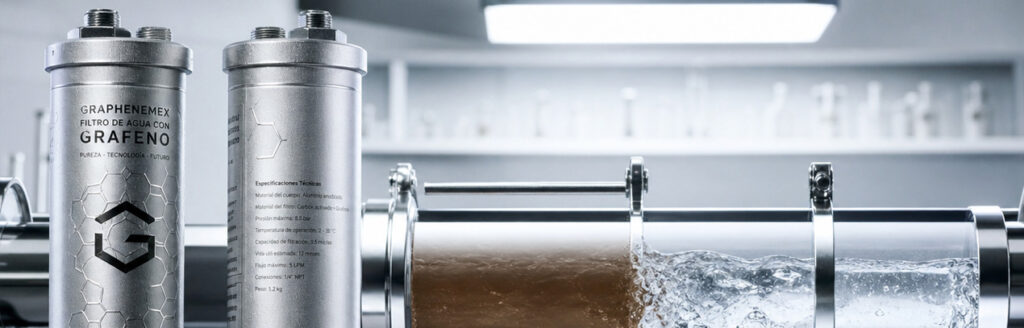
Fortunately, today, talking about graphene or graphene materials in real applications is no longer a milestone of the future, in fact, it is a reality that is transforming industries. So much so, that starting in 2022, industrial filters, portable cartridges, and graphene-based nanofiltration systems for water purification and contaminant removal began to enter the market. However, although this transition from the laboratory to the industry is a big leap, there are still few companies that have managed to bring this technology to industrial production, for example:
- Clean TeQ Water (Australia): Through its subsidiary NematiQ, it manufactures rolls of graphene oxide nanofiltration membranes for treatment plants;
- Medica S.p.A. (Italy): With a medical and domestic focus, it operates through its Graphil line;
- Icon Life Saver (United Kingdom): Developed Graphene:Ultra portable cartridges for the removal of heavy metals and chemicals;
- GYC Group (Asia): Provides composite filters and customized graphene additives.
Despite these success stories, the supply remains small for such high need and demand.
In this context, research carried out at the Autonomous University of San Luis Potosí (UASLP), under the direction of Dr. Mildred Quintana, studied the potential of different combinations of graphene materials for water filtration. The study entitled “Design of graphene nanocomposites for the development of membranes” was carried out as part of a 2025 doctoral thesis. The research compared the performance of graphene oxide and graphene heterostructures synthesized in the laboratory, with their counterpart designed from materials produced industrially by Graphenemex®.
The research was developed in two stages. First, the heterostructures synthesized in the laboratory were designed and studied to obtain reference data, and subsequently, their counterparts were prepared with Graphenemex® materials. The heterostructures were immobilized on PTFE and polyester supports by filtration, to then evaluate their performance regarding water permeation, dye removal, Na⁺ and Cl⁻ rejection, among other evaluations.
The comparison between both systems was made to determine if the materials produced industrially by Graphenemex® could reproduce the results offered by the heterostructures synthesized under controlled laboratory conditions.
“The materials produced by Graphenemex® retained the ability to interact and form functional heterostructures”
The results obtained are relevant because, within the different systems studied in the thesis, selectivities greater than 80% and permeances greater than 2500 L/(m²·h·bar) were achieved. These data coincide with other studies in which GO membranes deposited on nylon membranes have achieved rejections greater than 90% for organic molecules.
It should be clarified that the results of the thesis do not represent a finished commercial membrane, but they are part of a fundamental stage on the path to its technological maturation with 100% Mexican science and technology. The next step is to perfect this knowledge and transfer it to an increasingly relevant environment. In this case, through the immobilization of the heterostructures in a filtering material.
At Graphenemex®, we feel very proud of the possibility of being part of a solution to such an important global problem. The development of these technologies is not just an engineering achievement, it is a commitment to the planet and future generations.