When Graphenemex® Graphene Transforms Dentistry:
Stronger, Safer, and Antimicrobial PMMA
The world of dental materials is extensive and complex, encompassing a wide variety of materials from metals, ceramics, polymers, surgical, cements, impressions, and others, that have naturally progressed over time to provide greater mechanical functionality, aesthetics, biological, and/or microbiological performance.
In this evolutionary context, biomaterials science explores the use of graphene and its derivatives in dentistry due to their extraordinary theoretical properties: mechanical strength (Young’s modulus ~1 TPa), electrical conductivity (electron mobility >15,000 cm²/V·s), thermal conductivity (~5000 W/m·K), and chemical stability. These position graphene as an excellent candidate for developing restorative materials, bioactive cements, or those with improved adhesion or antimicrobial capacity, contributing to greater durability, better infection control, and long-term treatment success.
A widely used acrylic resin for manufacturing orthodontic and prosthetic appliances—and a research subject—is polymethyl methacrylate (PMMA). Due to its mechanical limitations and high contamination susceptibility, modifications have been evaluated, such as glass fiber, zirconia, titanium dioxide, graphene, and biocidal additives. Graphene stands out for its contributions to fracture resistance, dimensional stability, and reduced biofilm formation.
Biosafety is a primary concern for new materials. For graphene, this depends on its surface chemistry, concentration used, and whether particles are free or embedded in a polymer matrix, directly influencing interaction with surrounding tissues. In dental resins, toxicity often stems from leaching unreacted monomers and fillers, but this is mitigated by proper curing—via UV photopolymerization or thermal treatment—as per manufacturer specifications.
At appropriate concentrations, graphene leads to a denser polymer network, reduced monomer leaching, and improved biocompatibility. This enhances rigidity, compressive strength, and reduces wear rate for better durability through mechanisms such as:
- Absorbing incident light to promote photo initiator radicals,
- Facilitating energy or charge transfer to accelerate polymerization,
- Providing nucleation sites for cross-links,
- Reducing thermal expansion coefficient for long-term stability.

In Latin America, national graphene production and application are consolidating. In this scenario, the graphene produced by the Mexican company Energeia Fusion, under the brand Graphenemex®, since 2018 has undergone systematic studies for mechanical and antimicrobial properties in various materials. In 2023, the Nanomaterials Laboratory of the Master’s Program in Dental Sciences of the Faculty of Stomatology of the UASLP, incorporated it into research lines to analyze its effects in PMMA matrices, focusing on mechanical performance and biosafety in dentistry.
Investigations were conducted in two master’s projects directed by Dr. Juan Carlos Flores Arriaga, following ISO 7405 guidelines for biocompatibility evaluation of dental products and materials, and ADA No. 12 requirements for physical and chemical test methods of denture base resin materials.
Properties evaluated in PMMA modified with Graphenemex® graphene included:
1. Fracture resistance via stress, elasticity, and hardness analysis,
2. Characterization by microscopy (physical appearance), spectroscopy (molecular composition), and contact angle (liquid interaction changes),
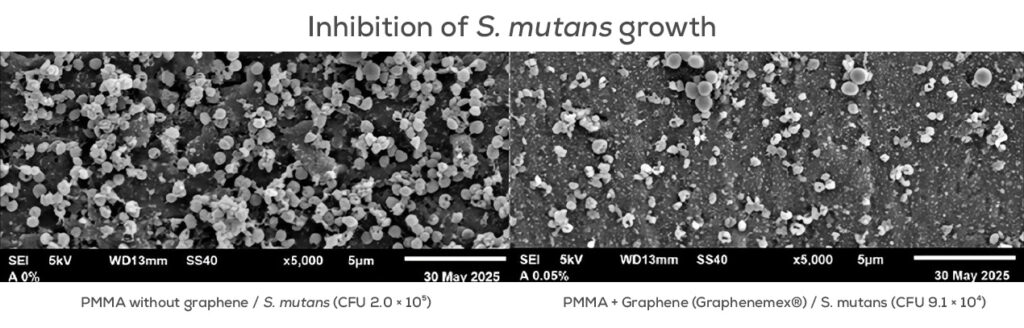
3. Antimicrobial capacity against main caries causative Streptococcus mutans, and others like Streptococcus sobrinus and Streptococcus oralis, associated with caries and biofilm (dental plaque),
4. In vitro cytotoxicity assays on fibroblasts L-929 per ISO 10993-51.2009 (E) for medical device safety.
Experimental results confirmed that Graphenemex® graphene in PMMA caused no harmful chemical changes to polymeric integrity but significant improvements in mechanical performance — 90-150% over conventional PMMA — meaning less deformation during chewing, greater wear and fracture resistance.
Additionally, increased hydrophobicity (per contact angle), microbial growth inhibition (mainly S. mutans), and scanning electron microscopy observations confirmed enhanced antimicrobial capacity, anti-biofilm properties, and—crucially—no compromised biocompatibility, as cytotoxicity tests showed no toxicity across evaluated concentrations.
In conclusion, proper incorporation of Graphenemex® graphene endows PMMA with effective antimicrobial properties without toxicity, positioning it as a multifunctional dental biomaterial with mechanical, biological, and preventive advantages against oral biofilm-related pathologies. This supports its clinical potential in prosthetic rehabilitation, orthodontics, and orthopedics.
Writing: EF/Dania Hernández
Sources :
1. https://repositorioinstitucional.uaslp.mx/xmlui/handle/i/9563
- De Toledo, P.T.A.; Nunes, G.P.; Ferreira, M.F.; Martins, T.P.; Peres, G.R.; Soares, D.G.; Esteves-Oliveira, M. Bonding Behavior of Graphene-Based Enhanced Restorative Materials: A Systematic Review and Meta-Analysis. Int. J. Adhes. Adhes. 2025, 141, 104046.
- Ben Ammar, T.; Roman, T.; Ba, H.; Ball, V.; Kharouf, N. Graphene and Related Materials: Properties and Applications in Dentistry. Materials 2025, 18, 5365. https://doi.org/ 10.3390/ma18235365
- Saghiri, M.A.; Saini, R.S.; Kuruniyan, M.S.; Mosaddad, S.A.; Heboyan, A. Graphene and Its Modifications for Enhanced Adhesion in Dental Restoratives: A Molecular Docking and Dynamics Study. Sci. Rep. 2025, 15, 9455.
- Janji´c, K.; Valentova, A.; Arellano, S.; Unterhuber, A.; Krause, A.; Oberoi, G.; Unger, E.; Tabrizi, H.A.S.; Schedle, A. The Impact of Print Orientation and Graphene Nanoplatelets on Biaxial Flexural Strength and Cytotoxicity of a 3D Printable Resin for Occlusal Splints. Dent. Mater. 2024, 40, 1742–1752.
- Ahmad, K.H.; Mohamad, Z.; Khan, Z.I. Influence of Graphene Nanoplatelets and Post-Curing Conditions on the Mechanical and Viscoelastic Properties of Stereolithography 3D-Printed Nanocomposites. Polymers 2024, 16, 2721.