Graphene: a revolution in the paper industry

Graphene:

a revolution in the paper industry


The paper industry represents a very broad and versatile market, in fact and despite the challenges it faces due to the impact of digital media and its competition with plastic, its world production continues to be considerable, exceeding 400 million tons distributed in products for containers and packaging, for hygienic and sanitary use, as well as paper for printing, writing and the press.

“It is estimated that by the end of 2022 cardboard will represent two thirds of world paper production”

On the other hand, the continuous need for innovation as well as the search for solutions to the problems inherent in these products, such as their easy contamination and permeability, have made nanotechnology remain an important tool with the use of different nanomaterials such as nano- cellulose crystals and nanofibers, nanoparticles of silicon oxide (SiO2), titanium dioxide (TiO2), zinc dioxide (ZrO2) and recently graphene materials such as graphene and graphene oxide (GO) 1 with the aim of design nano-scale building blocks to obtain denser and less porous networks that, in addition to improving the quality of the final product, also diversify its use.

“Cellulose, in addition to being one of the most abundant natural polymers on earth, is also the main raw material for the paper industry. Graphene is obtained from graphite, a very abundant carbon mineral in Mexico”

How do graphene materials benefit the paper industry?


When talking about graphene, the main points of reference are its resistance, impermeability, flexibility, conductivity, lightness, biocompatibility, etc., all in a single material. Given this, it is important to understand that the behavior of graphene materials will depend, among other things, on the type of graphene, functionalization and concentration, but also on the processes involved in each industry and the nature of the materials with which it will be combined to transfer its properties and therefore there is no exact formula for each usage target, for example:


Mechanical strength- In the case of cellulose films, the presence of as little as 0.5% GO can significantly improve tensile strength, elongation at break and fracture energy by 78%, 172% and 397%, respectively; useful for its application in high performance bioplastic films2.


Antimicrobial protection- Among the benefits of interest to the paper industry are its biocompatibility, its physical barrier properties and its antimicrobial activity. For example, a study that prepared a paper coating with 0.05% GO reduced the growth rate of bacteria such as E. coli and S. aureus by 73% and 53%, respectively3,4. This is because GO helps limit microbial adhesion, replication and penetration.
Protection against UV radiation- According to another report, the use of 2% GO in cellulose films blocks UVA and UVB radiation by 66.7% and 54.2% respectively, without affecting the transmission of visible light, an interesting property for the design of protection and packaging materials.5


Barrier properties- Graphene materials present nano-channels between their sheets that represent a tortuous path for the passage of large molecules and, therefore, it is widely investigated both for its great impermeability against liquids and gases, but also for its potential benefits for the decontamination, purification and even desalination of seawater. Research carried out on cellulose acetate (CA) membranes for desalination described that the use of 1% GO improves morphology, hydrophilicity, porosity, roughness, mechanical resistance, thermal stability and, therefore, its operating efficiency, as well as it has happened with other types of membranes such as polysulfone, in which a concentration of 0.2% GO can be enough to improve their performance by up to 72%, in terms of water flow and salt rejection in tests with sodium sulfate. sodium6,7. The foregoing is not only reflected in the efficiency of filtration and/or desalination, but also the optimization of maintenance resources and energy consumption of said systems.


Energeia- Graphenemex®, the leading company in Latin America in the design and development of applications with graphene materials, continuously works to solve the obstacles that graphene faces to reach the market and, through strategic alliances with other industries, seeks to make this technology available to the industry for solving various problems.


References

  1. Trache, D., Thakur, V. K., & Boukherroub, R. 2020., Cellulose nanocrystals/graphene hybrids—a promising new class of materials for advanced applications. Nanomaterials, 10(8), 1523.
  2. M. Akhtari, M. Dehghani-Firouzabadi, M. Aliabadi, M. Arefkhani. Effect of graphene oxide nanoparticle coatings on the strength of packaging paper and its barrier and antibacterial properties. 2019., Bois et Forêts des Tropiques. 342, 69.
  3. W. Hu, Ch. Peng, W. Luo, M. Lv, X. Li, D. Li, Q. Huang, and Ch. Fan. Graphene-Based Antibacterial Paper. 2010. ACS Nano, 4, 7, 4317–4323
  4. X. Liu, T. Zhang, K. Pang, Y. Duan and J. Zhang. Graphene oxide/cellulose composite films with enhanced UV-shielding and mechanical properties prepared in NaOH/urea aqueous solution. 2016., RSC Adv., 6, 73358
  5. Zhang, X. F., Song, L., Wang, Z., Wang, Y., Wan, L., & Yao, J. 2020., Highly transparent graphene oxide/cellulose composite film bearing ultraviolet shielding property. International journal of biological macromolecules, 145, 663.
  6. S. M. Ghaseminezhad, M. Barikani, M. Salehirad.  Development of graphene oxide-cellulose acetate nanocomposite reverse osmosis membrane for seawater desalination. Composites Part B: Engineering. 2019., 161, 15, 320.
  7. B.M. Ganesh, Arun M. Isloor, A.F.Ismail., Enhanced hydrophilicity and salt rejection study of graphene oxide-polysulfone mixed matrix membrane. 2013., Desalination., 313, 199.


The graphene revolution in the automotive industry: innovation in vehicle care and protection

The graphene revolution in the automotive industry:

innovation in vehicle care and protection

Just as continuous exposure to solar radiation is harmful to our skin, it also affects the appearance of cars, in particular it causes damage to paint, moldings, tires and other auto parts. In fact, the sun, acid rain and temperature changes are three of its main enemies, for that reason there are countless product options on the market for its care.

Graphene is the most interesting form in which Carbon can occur and consists of sheets of carbon atoms extracted mainly from Graphite or from some gases. The great scientific and technological relevance of this material is due to the particular organization of its atoms, which gives it surprising and numerous properties that have captured the attention of a large number of industries, including the automotive industry.

The potential uses attributed to Graphene for this industry are the manufacture of coatings for chassis and bodies, plastics for auto parts, either to improve their quality or to totally or partially replace metal parts, tires, textiles, greases, lubricants and products for car care.

Energeia- Graphenemex® dedicated to the research and production of graphene materials as well as the development of applications at an industrial level, in 2018 under the Nanocar® brand, placed on the market the first line of products with Graphene for automotive care.

Benefits:

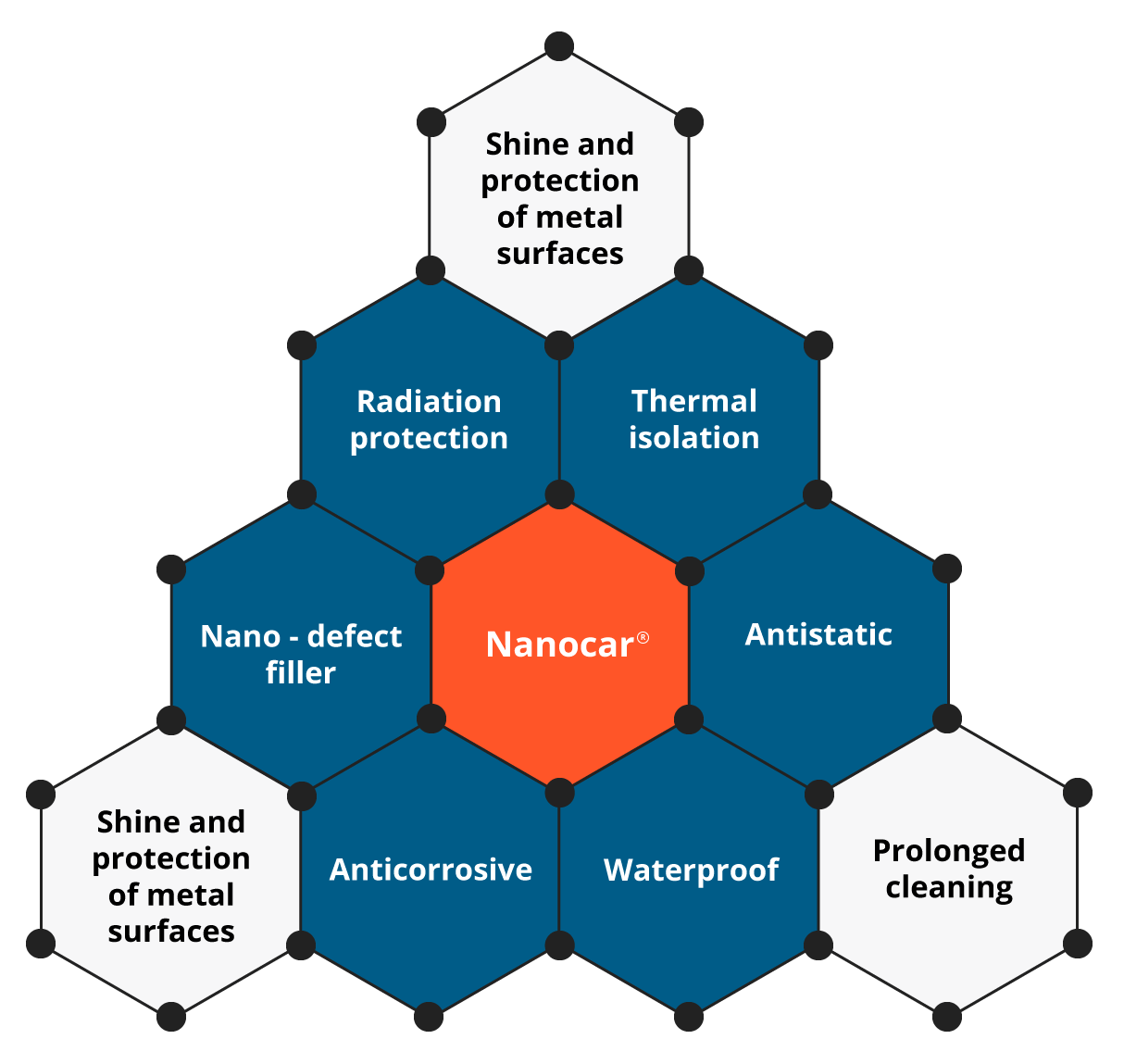
Nanocar® products form a protective and nano-filling film for defects that allows the atomic sheets of Graphene to adhere to the surfaces of the bodywork, protecting against dust and moisture, delaying the effects of corrosion, as well as acting as a barrier against UV radiation and as a temperature dissipator to limit the long-term deterioration of the paint. In addition, the continuous use of Nanocar® products facilitates subsequent cleaning, without leaving a trace of drying, even when washing is carried out with hot surfaces.

Relationship of the properties of Graphene and its effects on Nanocar® products

Drafting: EF/DHS

The rise of graphene: advances and developments in the last decade

The rise of graphene:

advances and developments in the last decade

Graphene is the most revolutionary nanomaterial of the 21st century and is considered the basic pillar for carbon nanochemistry, that is, the main element of all organic compounds.

Its versatility derives from its structure in the form of two-dimensional (2D) sheets, made up of carbon atoms linked in a hexagonal manner, and its importance lies in the extraordinary properties attributed to it and that have been conceived as the solution to innumerable social, environmental, scientific, technological and of course, economic needs.

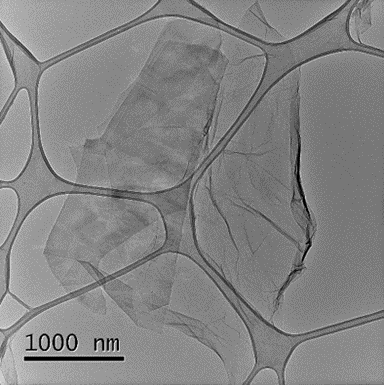
Graphene sheet. High Resolution Transmission Electron Microscopy.
Energeia Collection – Graphenemex

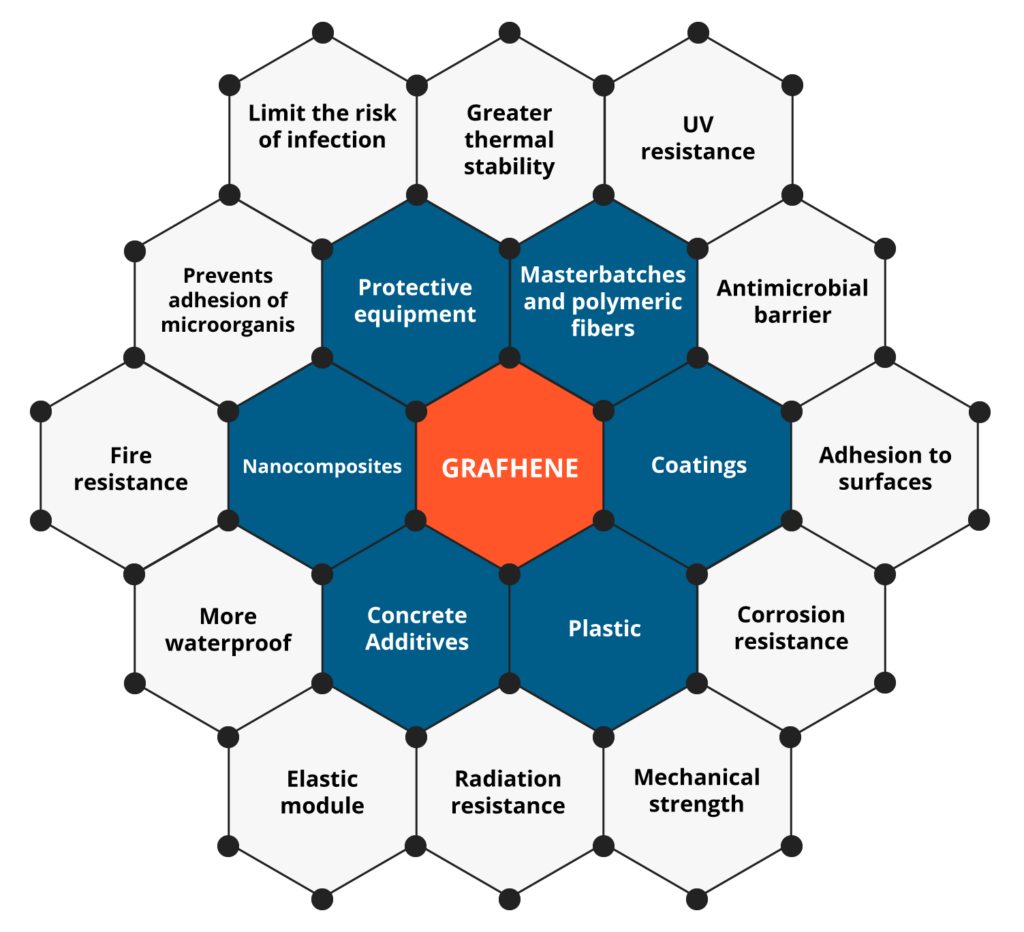
Graphene allows matter to be modified to design compounds with new or improved characteristics, since it transfers its properties to the materials to which it is incorporated. This has allowed it to be used in the development of applications that seek to potentiate these properties, as shown in the following image.

Evolution – Graphene was first isolated in 2004 by Russian researchers Andre Geim and Konstantin Novoselov from the University of Manchester; subsequently, and thanks to their experiments, in 2010 they were awarded the Nobel Prize in Physics, as it was considered one of the most important discoveries of the century.

So important was the finding that in 2013 the European Union (EU) granted a budget of one billion euros to create the Graphene Flagship, an ambitious project valid for ten years with the aim of linking academia with industry, not only to understand its properties theoretically, but to fully exploit its benefits in real applications or products.

From that moment on, the progress of the investigations was so fast, and the expectations were higher and higher that, in 2017, the first edition of the ISO/TS 80004-13:2017 standard emerged (Ratified by the Spanish Association for Standardization in October 2020) for the normalization and standardization of Nanotechnology in new materials, including Graphene.

In the same 2020, a group of 70 researchers who are members of the Graphene Flagship, published the first manual with more than 500 pages on countless types of Graphene. By 2021, around 50 “spin-offs” and “startups” with different visions were registered within the organization, making the possibility of having a greater number of applications with Graphene or graphene materials at more affordable costs a reality by 2022.

In 2021 again the EU through the Federal Institute for Materials Research and Testing (BAM) with the new ISO-G-SCoPe project, set the objective of standardizing the methods to transfer Graphene to the industry, this as a result of the non-existence of production and quality standards, while, through the Versailles Project on Advanced Materials and Standards, under the direction of BAM, it seeks to validate the processes in a global test to convert them into standards.

Energeia Graphenemex® is the pioneer Mexican company in Latin America focused on the research and production of graphene materials for the development of applications at an industrial level. Among its strengths is the creation of patented methods and processes for replicable and large-scale production that ensures the availability of the appropriate graphene materials in accordance with the requirements of the applications it develops, either for its own products or as a strategic ally of other companies interested in innovating and improving their products with these materials.