Graphenemex and the Future of Energy Storage: Scientific Evidence from the Autonomous University of Chihuahua 

Graphenemex and the Future of Energy Storage:

Scientific Evidence from the Autonomous University of Chihuahua 

The development of advanced materials for energy storage has become a global priority. More efficient batteries, long-lasting supercapacitors, and flexible electronic devices require materials capable of conducting electricity, withstanding electrochemical cycles, and maintaining structural stability at the nanoscale. 

In this context, various investigations led by Dr. Claudia Georgina Nava-Dino from the Autonomous University of Chihuahua (UACH), in collaboration with CIMAV and other national research centers, have evaluated the performance of Graphenemex® exfoliated graphene and graphene oxide (GO) in applications related to energy storage systems and advanced electrochemistry. 

In general terms, these nanomaterials have demonstrated important properties for such systems due to their combination of: 

  • high surface area, 
  • electrical conductivity, 
  • electrochemical stability, 
  • nanometric lamellar structure, 
  • ability to interact with lithium, titanates, and metal alloys, 
  • and favorable behavior under mechanical milling processes and electrochemical cycles. 

Below is a timeline of research led by Dr. Claudia Nava-Dino, where the potential of Graphenemex® exfoliated graphene and graphene oxide for applications related to batteries, supercapacitors, and advanced energy storage has been studied. 

2018 — Digital Signal Analysis of Electrochemical Signals of Graphene Oxides for Display Devices.  

The work published in Cambridge University Press in 2018 explored the electrochemical behavior of GO combined with lithium titanate oxide through high-energy mechanical milling, observing that the material could maintain distinguishable and structurally stable electrochemical signals even under current and potential perturbation analysis. 

For the research, in addition to graphenic materials, electrochemical analysis techniques and digital signal processing were used to study their stability and response under complex electrochemical conditions. 

“Lithium titanate is one of the most promising materials for fast-charging batteries, long-life systems, and safe electrochemical storage. Therefore, the incorporation of a graphenic material in this type of system seeks to improve conductivity, stabilize interfaces, and facilitate electron transfer between active particles.” 

One of the most important findings was that the electrochemical signals obtained from the material could be analyzed and stabilized using FFT (Fast Fourier Transform), allowing the identification of information that is normally not visible in conventional analysis. That is, the GO demonstrated good electrochemical stability, reproducible electrical responses, and a favorable interaction with lithium-based active materials. 

GO with a stable nanometric structure. 

This study also reported TEM images showing the characteristic hexagonal flakes of a well-exfoliated material. Which is relevant for fast electron transfer, electrical conduction between particles, and the reduction of internal resistances in electrodes, which in real applications translates into more efficient batteries, lower energy loss, and more stable electrodes during charge and discharge cycles. 

Flexible electronics and portable devices . 

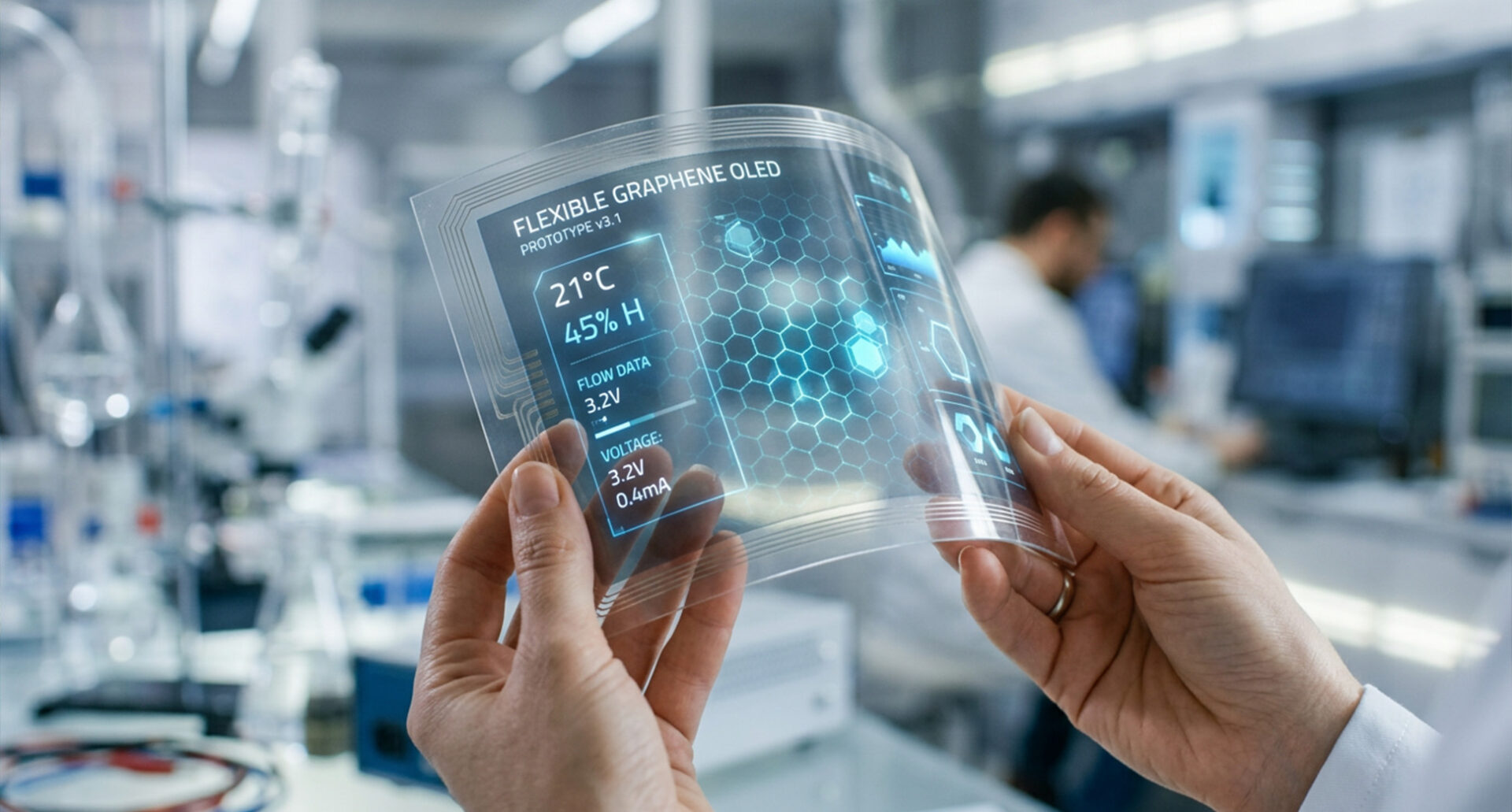
Another relevant aspect of the 2018 work was the evaluation of electrochemical stability against mechanical deformations such as bending and twisting in portable electronic devices, which is especially relevant because many conductive materials lose connectivity when mechanically deformed. Pleasantly, the GO used presented good structural integrity and conductive connectivity even in mechanically demanding configurations. Identifying potential for the development of conductive screens, flexible devices, OLEDs, touch screens, and portable electronics. 

2023 – Within the framework of the International Materials Congress, held in Cancun, Quintana Roo, the work “Benefits of Exfoliated Graphene on Lithium Titanate by Ball Milling” was presented, in which the compatibility of Graphenemex® exfoliated graphene with lithium titanate was evaluated ; the study was carried out in Li/Na systems using high-energy mechanical alloying, observing benefits associated with milling time and the structural interaction between graphene and the active storage phases. 

2024 — Graphene-reduced Mg-Ni electrode for energy storage by mechanical alloying.  

During the Congress of the Mexican Electrochemical Society (SMEQ), held in the City of Campeche, Camp., the research group presented new results related to graphene-reduced Mg-Ni electrodes for energy storage. In this work, the GO was incorporated through mechanical alloying at different milling times, followed by thermal treatments and electrochemical polarization and voltammetry tests. 

In practical terms, the result was that the graphenic material helped maintain stability during repeated charge and discharge processes, one of the most important properties in supercapacitors, hybrid batteries, and advanced electrodes. 

Compatibility with high-energy processes  

The investigations also showed that graphenic materials possess sufficient structural stability to withstand intense mechanical impacts, energetic mixing, thermal treatments, and subsequent electrochemical processes without completely losing their functional properties, and consequently can be integrated into severe manufacturing processes such as: 

  • high-energy mechanical milling, 
  • thermal treatments, 
  • mixing with metal salts, 
  • and advanced electrochemical synthesis. 

This is important because many nanomaterials lose structural functionality during these processes. However, the reported results indicate that the materials used retained relevant functional properties even after processing. 

What capabilities do these graphenic materials show?  

The research developed by the Autonomous University of Chihuahua, CIMAV, and collaborators, under the direction of Dr. Claudia Nava-Dino since 2018, has provided relevant scientific evidence regarding the potential of Graphenemex® exfoliated graphene and graphene oxide in energy storage technologies, as they have consistently demonstrated improvements in electrochemical stability, electronic conduction, and cyclic performance. 

Today, more recent studies help to scientifically explain why this behavior occurs. An example is the article published by V. Bracamonte et al., in Batteries & Supercaps, 2026, where it is demonstrated that exfoliated graphene (Graphenemex®) offers a structural balance between electrical conductivity, controlled defects, and layer separation, favoring the mobility of lithium ions within the material. 

These observations directly coincide with the results reported by C. Nava-Dino, reinforcing the potential of Graphenemex® graphenic materials for future applications in batteries, supercapacitors, and advanced energy storage devices. Beyond conventional applications, the studies also open up possibilities for integrating these nanomaterials into flexible electronics, smart devices, and advanced portable energy systems. 

Written by: EF/Dania Hernández 

More Energy, Faster Charging, and Longer Lifespan: Graphenemex® Graphene in Batteries 

More Energy, Faster Charging, and Longer Lifespan:

Graphenemex® Graphene in Batteries

From mobile phones to electric vehicles, modern life depends on lithium-ion batteries. Although this technology has been widely used since the 1990s, it still faces limitations such as long charging times, performance degradation with use, and constraints in capacity and efficiency. 

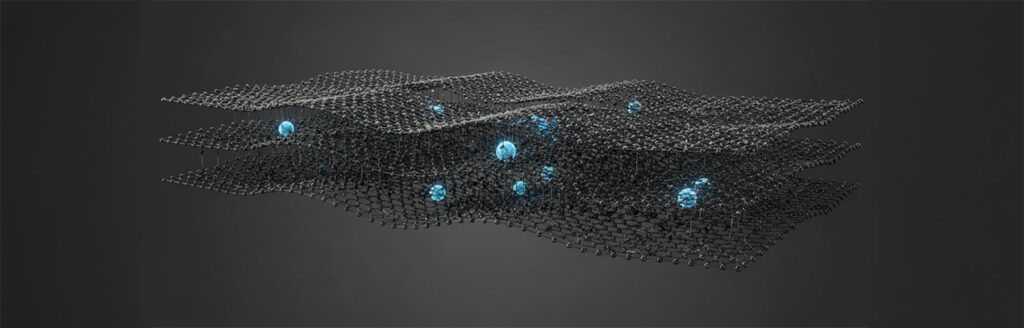
To overcome these barriers, materials science has turned its attention to graphene—a two-dimensional material composed of carbon atoms arranged in a hexagonal lattice—which offers a wide range of exceptional mechanical, thermal, and electrical properties. Among the various production routes reported worldwide, graphene developed by Graphenemex® has demonstrated particularly attractive characteristics for energy-related applications. 

Graphene or Graphite? 

It is widely known that graphite is the standard material used in the anodes of commercial batteries. However, what is less commonly understood is that graphite is composed of millions of graphene layers tightly stacked together. In graphite, these graphene sheets are so closely bound that the movement of lithium ions during charge and discharge cycles is restricted, leading to the limitations mentioned above. 

“Graphite acts as the reversible storage material for lithium ions, allowing the battery to charge and discharge energy by intercalating and extracting these ions between its layers.” 

Why Does Graphene Improve Lithium Battery Performance? 

Exceptional electrical conductivity 

Graphene exhibits extraordinarily high electrical conductivity due to its sp² carbon structure with delocalized π electrons. In lithium batteries, this allows electrons to move with lower resistance between the active electrode material and the current collector, enabling much faster electron transport. 

Improved lithium-ion transport 

Thanks to its two-dimensional structure and the possibility of increasing interlayer spacing, graphene reduces the distance and barriers lithium ions must overcome within the electrode. This improves charging speed, electrochemical efficiency, and high-rate performance. 

High surface area 

Graphene’s large surface area provides more active sites for lithium storage and better contact between the electrode and the electrolyte, increasing the effective area for electrochemical reactions. 

Enhanced mechanical stability 

Most electrode materials expand and contract during charge–discharge cycles, leading to degradation. Graphene acts as a mechanical buffer against these volume changes, reducing degradation and significantly extending battery lifespan. 

How Is the Future of Graphene Batteries Shaping Up? 

According to data from the global market research firm Fortune Business Insights, the graphene battery market was valued at USD 211.87 million in 2025 and is expected to grow to USD 1,508.75 million by 2034, driven by the global transition toward high-performance energy storage technologies. Major companies involved in research and adoption of graphene-based batteries include Samsung Electronics, Panasonic Corporation, Huawei, Log 9 Materials, Cabot Corporation, Graphenano, Nanotech Energy, Nanotek Instruments Inc., XG Sciences, ZEN Graphene Solutions Ltd., GrapheneCA, Global Graphene Group, Vorbeck, Graphenea, Hybrid Kinetic Group Ltd., and Targray. 

Beyond economic profitability, sustainability is a critical factor. The adoption of graphene in battery manufacturing can reduce dependence on critical raw materials such as lithium, improve recyclability, decrease frequent replacements, and consequently reduce carbon footprint—aligning with the goal of achieving net-zero emissions by 2050. 

What Is Mexico’s Contribution to This Value Chain? 

 Energeia–Graphenemex® is the leading Mexican company in Latin America dedicated to the production and commercialization of graphene-based materials and the development of applications. Although its product portfolio does not yet include a graphene battery, its materials are currently being evaluated under strict research protocols at major national and international research centers.  

Picture: Victoria Bracamonte 

In a 2025 study led by Dr. Victoria Bracamonte and collaborators from the Sustainable Energy Laboratory (LAES), Enrique Gaviola Institute of Physics (IFEG), Faculty of Mathematics, Astronomy, Physics and Computing (FaMAF), and Faculty of Chemical Sciences at the National University of Córdoba, Argentina, the performance of commercial graphite was compared against the exfoliated graphene from Graphenemex® as anode materials in batteries. The objective was to explore lithium-ion diffusion properties and high-rate performance. 

After comprehensive structural and electrochemical analyses, the results showed that: 

  1. Graphene (Graphenemex®) achieved up to five times higher energy storage capacity than graphite. 
  1. Graphene enabled higher charging rates, retaining more than 50% of its capacity, significantly outperforming graphite. 
  1. Graphene exhibited lower charge-transfer resistance and more efficient Li⁺ diffusion compared to graphite, indicating superior battery performance. 

These results are consistent with other reported studies, with the added advantage that Graphenemex® graphene is produced using an eco-friendly, scalable, and low-cost method, positioning it as an accessible technological platform for both academic research and industrial applications. 

Writing: EF/Dania Hernández 

Sources: 

  1. From Theory to Experiment: Reviewing the Role of Graphene in Li-Ion Batteries Through Density Functional Theory. Nanomaterials 2025, 15, 992. 
  1. The role of graphene in rechargeable lithium batteries: Synthesis, functionalization, and perspectives. Nano Materials Science 7 (2025) 818–836 
  1. High power and energy density graphene phase change composite materials for efficient thermal management of Li-ion batteries. Energy Storage Materials 75 (2025) 104003 
  1. Graphene, inorganic graphene analogs and their composites for lithium ion batteries J. Mater. Chem. A, 2014, 2, 12104 
  1. https://www.fortunebusinessinsights.com/es/graphene-battery-market-105711 
  1. https://chargeasap.com/blogs/news/how-panasonics-graphene-battery-redefines-mobile-charging#:~:text=One%20company%20at%20the%20forefront%20of%20graphene,and%20shape%20the%20future%20of%20mobile%20charging
  1. https://nanotechenergy.com/graphene-products/graphene-batteries/ 
  1. https://graphenemg.com/gmg-unveils-graphene-aluminium-ion-battery-that-fully-charges-in-6-minutes/ 
  1. https://revistacloud.com/graphenegpu-la-tecnologia-de-grafeno-que-revoluciona-el-consumo-energetico-en-centros-de-datos-para-ia/ 

Graphene in protection against electromagnetic radiation

Graphene in protection

against electromagnetic radiation

The development of communication technology together with electronic devices has generated great concern regarding the electromagnetic radiation emitted by these technologies.

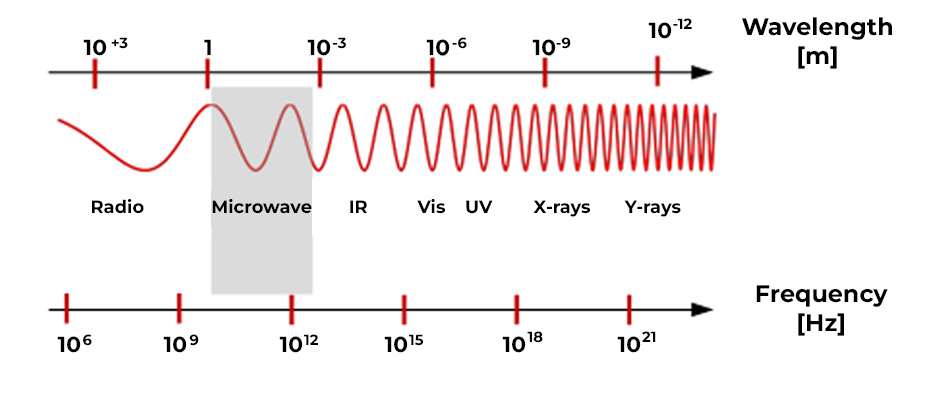
Electromagnetic radiation is a type of electromagnetic field, that is, a combination of oscillating electric and magnetic fields, which propagates through space carrying energy from one place to another. Electromagnetic radiation can manifest itself in various ways, such as radio waves, microwaves, infrared radiation, visible light, ultraviolet radiation, X-rays or gamma rays and correspond to different wavelengths, ranging from kilometers (radio waves) to the order of picometers (gamma rays). The full range of wavelengths is what is called the electromagnetic spectrum (Figure 1.).

Electromagnetic radiation can be high frequency (radiation from mobile and wireless telephones, radio frequencies, TV waves, microwaves, radar, satellite signals, Wi-Fi, Bluetooth) and low frequency (fields generated by cables or electrical consumers).

Heat and electromagnetic radiation (EM radiation) are unavoidable by-products in electronic devices, especially those that operate at high frequencies. As electronic devices get smaller, they operate at higher and higher frequencies, generating even more heat and electromagnetic waves.

High frequency electromagnetic radiation not only degrades the devices themselves (producing heat), but also tends to interfere with neighboring electronic devices and most importantly, it has an adverse effect on human health as it can cause many diseases, such as leukemia, miscarriages, and brain cancer.

Therefore, the blocking or protection (shielding) against electromagnetic radiation could be one of the solutions to minimize health risks and for the protection of electronic equipment and/or devices. Metals are natural electromagnetic blocking materials, capable of reflecting electromagnetic waves due to their free electrons, which explains their high electrical conductivity and low penetration depth. However, their heavy weight, cost and the susceptibility of metals to corrosion make their use limited if not impossible.

The use of conductive coatings or paints to block electromagnetic radiation is the most viable option to solve the problem. Graphene is currently the most revolutionary nanotechnological additive in the coatings industry. Because graphene has extraordinary properties, which include high electrical conductivity, high thermal conductivity, and mechanical resistance. In addition, it possesses other distinctive properties, including gas impermeability, chemical resistance, antibacterial potential, and large surface area.

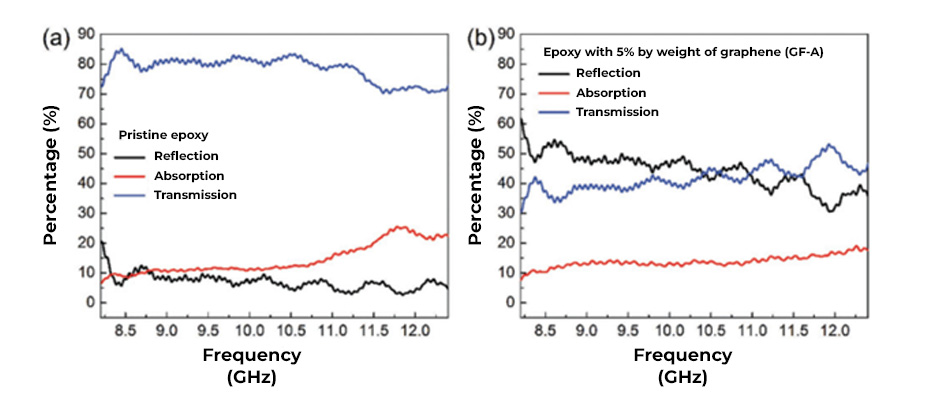
The electrical conduction capacity and thermal conductivity of graphene can be exploited in the formulation of shielding coatings against EM radiation, since graphene forms a continuous network along the surface of the coating, creating homogeneous films that block radiation. electromagnetic radiation while dissipating excess heat. In recent studies, it has been reported that the incorporation of carbon-based nanostructures, such as graphene in coatings or paints, allows the development of coatings with high electrical conductivity for shielding or protection against electromagnetic interference (EMI). The way to act with respect to high frequency electromagnetic waves is by refraction. Electromagnetic waves will bounce (reflect) off the treated surface similar to the effect of a mirror with respect to light (See Fig. 2). The barrier-effect in the propagation could be attributed to the contribution coming from the reflection capacity, the absorption and multiple internal reflections. The shielding efficiency increases with the addition of a higher concentration of graphene in the polymeric matrix of the coating. These graphene coatings can block more than 99.98% of high-frequency electromagnetic radiation.

Figure 2. Percentage of Reflection, absorption and transmission of pristine epoxy (a) and epoxy with graphene (b).
Taken from Adv. Electron. Mater. 2019, 5. 1800558

These coatings against electromagnetic radiation can act for both high frequency and low frequency, with an excellent quality of attenuation (decrease in intensity of signals or electric waves) of up to 38 dB, with one hand, and 47 dB if applied. two hands.

Energeia – Graphenemex®, a leading Mexican company in Latin America in research and production of graphene materials for the development of applications at an industrial level, through its Graphenergy line, is constantly researching and developing new multifunctional coatings and currently has for sale a wide range of nanotechnological coatings with graphene. Shielding coatings against electromagnetic radiation are currently being developed and evaluated. Coatings with high electrical conductivity, to reduce high and low frequency electrical fields respectively. These coatings will also offer anticorrosive and antimicrobial protection. In addition, to provide high resistance to wear, resistance to UV rays, impermeability and extraordinary adhesion.

Referencias

  1. Suneel Kumar Srivastava, Kunal Manna, Recent advancements in the electromagnetic interference shielding performance of nanostructured materials and their nanocomposites: a review, Journal of Materials Chemistry A, 10.1039/D1TA09522F, 10, 14, (7431-7496), (2022).
  2. Kargar, F., Barani, Z., Balinskiy, M., Magana, A. S., Lewis, J. S., Balandin, A. A., Adv. Electron. Mater. 2019, 5, 1800558.
  3. Seul Ki Hong et al 2012 Nanotechnology 23 455704.
  4. Lekshmi Omana, Anoop Chandran*, Reenu Elizabeth John, Runcy Wilson. Recent Advances in Polymer Nanocomposites for Electromagnetic Interference Shielding: A Review. Omega 2022, 7, 30, 25921–25947