Graphene in Agriculture:
The Silent Revolution That Will Feed the World
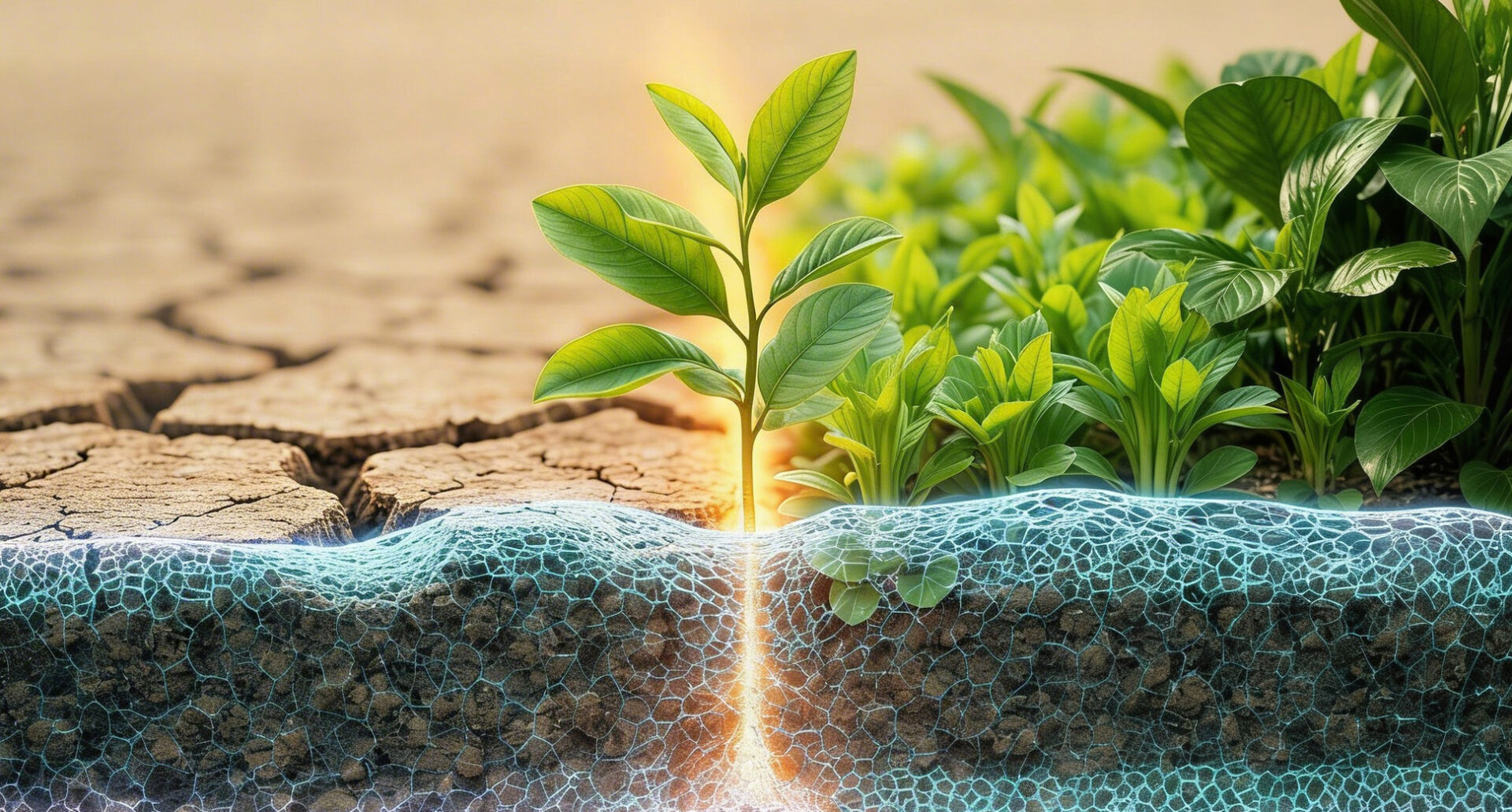
Optimizing food production with fewer resources and minimal environmental impact remains a constant challenge for agriculture in the face of growing global demand. In this context, over the past decade, experts in nanotechnology have initiated multiple research lines focused on graphene, aiming to generate evidence of its effects on plant species and, consequently, evaluate its feasibility for subsequent use in the agricultural industry.
What is the importance of graphene for agriculture?
From a physicochemical standpoint, graphene is a two-dimensional sheet of carbon atoms arranged in a hexagonal lattice, only one atom thick. This seemingly simple structure is responsible for its extraordinary properties, including electrical and thermal conductivity, mechanical strength, hydrophobicity, among many others, which collectively are unmatched by any other material.
“Surface chemistry, concentration, and interaction mechanisms of graphene are critical factors for improving agricultural productivity.”
On the other hand, graphene oxide (GO) is the most extensively studied variant due to its surface chemistry, characterized by the presence of hydroxyl, epoxide, carbonyl, and carboxyl groups. These functional groups transform graphene’s inherently hydrophobic nature into a hydrophilic form, enabling not only the formation of stable and biocompatible aqueous dispersions but also converting it into a chemical exchange platform capable of anchoring nutrients, capturing contaminants, and interacting with other nanoparticles, molecules, or components of agricultural interest.
A practical example is the potential of GO as a fertilizer coadjuvant. As is well known, one of the major issues with fertilizers is their low efficiency, since a significant portion volatilizes or leaches, contaminating water bodies and soils. In this case, it is hypothesized that the functional groups distributed across the graphene surface can encapsulate nutrients and subsequently release them gradually, preventing losses and, consequently, reducing environmental contamination.
“While graphene provides the structural foundation and physical properties, it is graphene oxide that enables its practical use in agriculture, as it translates graphene’s properties into a language that living systems can understand.”
Below is a chronological overview of some of the most relevant advances in graphene research applied to agriculture:
Between 2010 and 2012, researchers in China and the United States studied the impact of GO on lettuce, rice, and tomato crops. By exposing seeds to aqueous solutions containing 0.001 to 0.1 g/L of GO, the primary objective was to determine its penetration capacity and possible effects on germination. Surprisingly, scientists observed that at low concentrations, GO enhanced germination, root growth, and photosynthesis, possibly by facilitating water uptake and triggering enzymatic activation.
Between 2013 and 2016, research continued to better explain these phenomena. Instead of merely exposing seeds to GO dispersions, scientists designed experiments that incorporated environmental variables, such as plant growth in pots. This allowed the analysis of factors like water availability and nutrient dynamics, leading to the conclusion that graphene oxide could indeed retain water, improve seed hydration, and adsorb nutrients, keeping them available near the root zone. In other words, GO was found to optimize the plant microenvironment.
Given these findings, it became evident that studies needed to be conducted in more representative environments. Thus, between 2016 and 2019, researchers in India and China extended experiments to greenhouses, hydroponic systems, and full crop cycles, particularly in rice and wheat. They evaluated biomass, photosynthesis, and even quantified plant hormones. Results consistently showed that GO acted as a biostimulant, promoting growth and improving photosynthetic efficiency.
With so many positive outcomes, the focus shifted from whether graphene enhanced plant growth to whether it could help plants survive under adverse conditions. Consequently, between 2019 and 2021, researchers in the United States and Europe discovered that GO not only promotes growth but also enhances plant survival under drought and salinity stress, as explained below:
Salinity
To simulate saline conditions, sodium chloride solutions ranging from 50 to 120 mM were used to induce water loss, ionic imbalance, and oxidative stress in plants. Importantly, in the presence of GO—whether applied to soil, via foliar spraying, or in hydroponic systems—plants maintained ionic balance, increased antioxidant enzyme activity, and preserved photosynthetic performance.
Drought
Various methodologies are typically used to simulate drought conditions, such as reducing or suspending irrigation, or employing agents like polyethylene glycol to lower water potential without physically removing water. In all cases, GO integration follows a similar approach: direct application to the soil, followed by evaluation of plant responses. One key observation was that under drought conditions, GO does not always internalize within the plant but may remain in the soil, retaining water, reducing evaporation, and increasing water availability duration. In this sense, GO can function as a soil conditioner.
Oxidative Stress
In summary, both salinity and drought induce oxidative stress in plants, defined as an imbalance caused by excessive reactive oxygen species (ROS), commonly known as free radicals, which can lead to cellular damage or death. In this context, studies indicate that while GO does not prevent stress factors, it enhances plant resilience by activating antioxidant enzymes, retaining water, enabling osmotic adjustment, and regulating hormonal responses.
Thus, between 2022 and 2025, particularly in India, the concept of “nano-priming” emerged. This technique involves the preconditioning of seeds or plants through controlled hydration to activate their metabolism prior to actual growth, with the aim of improving germination and stress tolerance. To date, nano-priming with GO has demonstrated improved germination rates, stronger root systems, activation of antioxidant defenses, and enhanced stress response.
With all these scientific advances, graphene oxide is increasingly consolidating its role as a key agricultural tool to improve soil microenvironment conditions, optimize water usage, and strengthen crop resilience.
Consequently, Energeia-Graphenemex reaffirms its commitment to Mexican innovation through a collaboration with the Bionanotechnology Laboratory of the Institute of Physics (UASLP), led by Dr. Daniela Salado. Within the framework of the Institutional Doctorate in Materials Science and Engineering (DICIM-UASLP), and with the participation of student Sarahi Josefina Estrada Loredo, a research line was launched in 2025 to analyze the interaction of nanomaterials—including graphene and graphene oxide (Graphenemex®)—with strategic crops. We look forward to sharing the results of this important project in the near future.
Editing: EF/Dania Hernández
References
- Niu, Y.-X., Yao, X.-Y., Won, J. H., Shen, Z.-K., Liu, C., Yin, W., Xia, X., & Wang, H.-L. (2026). Application of graphene oxide nanomaterials in crop plants and forest plants. Forests, 17(1), 94. https://doi.org/10.3390/f17010094
- Chen, Z., Zhao, J., Cao, J., Zhao, Y., Huang, J., Zheng, Z., Li, W., Jiang, S., Qiao, J., Xing, B., & Zhang, J. (2022). Opportunities for graphene, single-walled and multi-walled carbon nanotube applications in agriculture: A review. Crop Design, 1, 100006. https://doi.org/10.1016/j.cropd.2022.100006
- Yang, Y., Zhang, R., Zhang, X., Chen, Z., Wang, H., & Li, P. C. H. (2022). Effects of graphene oxide on plant growth: A review. Plants, 11(21), 2826. https://doi.org/10.3390/plants11212826